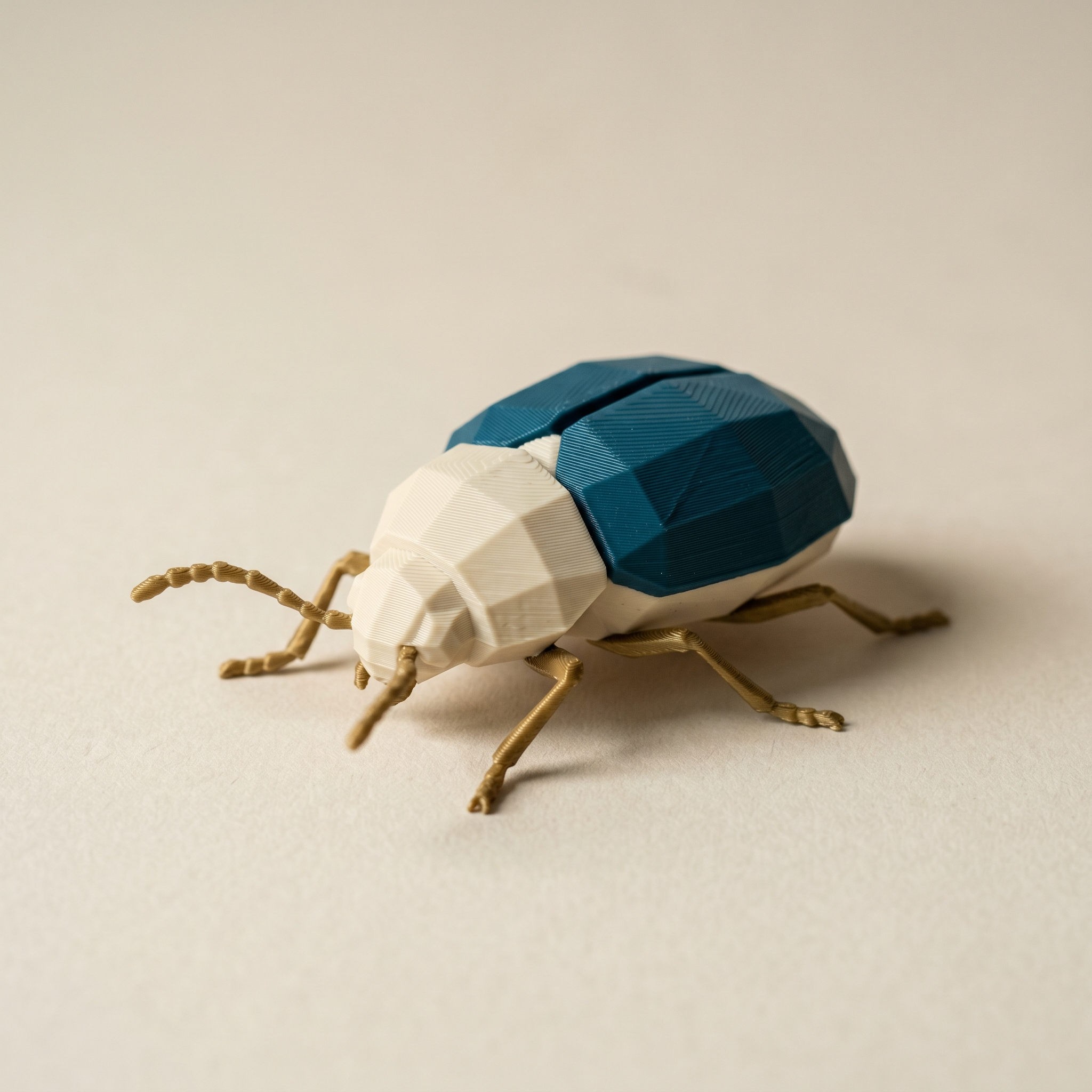
TL;DR: Slicers silently drop painted patches narrower than their outer-wall line — your thin stripe just vanishes from the print, with no warning. Layerpaint's Discard risk overlay flags every patch below your extrusion width in red before you export, so you can widen it with Grow or merge it. Here's how to set it up and fix what it finds.
Why do thin painted areas disappear from the print?
A slicer can't extrude a bead narrower than its outer-wall line width, so any painted patch thinner than that gets dropped at slice time — silently, with no preview warning. What matters isn't raw width but effective width: 2 × area ÷ boundary length. A 10 mm by 0.3 mm stripe has an effective width of 0.3 mm and vanishes; Bambu Studio, OrcaSlicer, and PrusaSlicer all behave this way.
You painted a tidy red stripe down the side of a low-poly figure. The slicer mapped every color to an AMS slot. The print came off the plate and the stripe is gone, or it fades in and out across two layers. The slicer wasn't broken. It can't extrude a bead narrower than its outer-wall line, so it threw the stripe away.
If you just want to read a dimension off the model before you commit to anything, the free STL viewer measures distances and gives you the bounding box in your browser.
Bambu Studio, OrcaSlicer, and PrusaSlicer all silently drop painted patches that fall below the outer-wall width at slice time. No warning in the preview. No log entry. You find out from the printed part.
The geometry isn't measured in straight millimetres of width. It's area over perimeter. For a long strip the formula 2 × area / boundary length is the effective width. A 10 mm long, 0.3 mm wide stripe has effective width 0.3 mm. A circle of the same area has effective width close to its diameter. Same maths, every shape.
Flip the Discard risk overlay
Open Layerpaint and switch to the Check tab. Scroll to the Discard risk section. Set Extrusion width to the outer-wall width your slicer profile uses. The Layerpaint default of 0.42 mm matches a typical 0.4 mm nozzle. The slider runs from 0.2 mm to 1.2 mm.
Toggle Show discard risk on. Every painted patch whose effective width is under that number turns red on the mesh. Red, yellow, cyan, magenta, and green are one-click swatches if red clashes with your palette, and a color picker covers the rest.
Set the extrusion width before toggling the overlay on, then drag the slider while watching the mesh. Borderline patches appear and disappear as you sweep across plausible profile widths. Useful when you don't know your slicer's exact outer-wall setting.
Fix a flagged patch: widen or merge
Each red patch needs a decision. Widen it so the slicer keeps it, or accept it's lost and roll it into a neighbour.
Widen with Grow. Pick the Grow tool from the toolbar. Click a face inside the flagged patch. Layerpaint floods that color outward into adjacent faces of any other color, stopping at the next color change. Click again to keep expanding. Use this when the patch is a detail you care about, like a sword edge, a piped seam, or a small logo.
Merge with Process discards. Hit Process discards. It finds every flagged region in one pass and repaints each one into the color it shares its longest border with. Hull edges don't count toward that border. Ties prefer painted neighbours over unpainted faces. Use this when there are dozens of slivers from auto-partitioning a noisy STL and you don't want to fix them one by one. The action snapshots for undo, so Ctrl+Z brings the slivers back.
The decision is about intent. Grow when you painted the patch on purpose and the slicer is about to delete a real choice. Process when the patch is noise the slicer would have re-attached to a neighbour anyway. You're just doing it visibly so you can review.
Set the right extrusion width
Your slicer's outer-wall width is the number that matters, not the nozzle diameter. They're not the same. Layerpaint's 0.42 mm default matches the common Bambu Studio outer-wall width for a 0.4 mm nozzle. Other slicers and other nozzles will be different. Check your filament profile for outer wall line width (Bambu Studio) or external perimeter extrusion width (PrusaSlicer).
If you can't find it, set the slider slightly above your best guess. A patch that gets flagged but ends up surviving is a cheaper mistake than one the slicer eats.
Run Fill borders in the same Check tab before flipping the overlay. It grows each painted region one step outward into unpainted neighbours and often clears the slivers before they show up as flags at all.
Common questions
Does this catch every slicer's behaviour?
It catches the most common reason a painted region disappears, which is that the slicer can't extrude a line narrower than its outer-wall width. It does not catch height-based drops (regions only one layer tall on top surfaces) or visibility issues from light filaments printing over a different-colored infill. For those, scrub through layers in the Layers section or watch the swap bar preview.
What about thin patches on text or inscriptions?
Embossed text and engravings often paint as long ribbons that pass the test until they thin at letter corners. The overlay flags the corners on their own. Either widen each corner with Grow, accept that the slicer will round the letter shape, or paint the text with a wider boundary that swallows the corners in the first place.
Will Fill borders fix this for me?
Fill borders only grows painted regions into unpainted neighbours. It doesn't change which painted regions are too thin. Use it before flipping the overlay so unpainted slivers get cleaned first, then run the discard check on what's left.
Try it now
Layerpaint runs in your browser. No install, no upload, no account. Drop an STL on the painter and start painting. When you're ready to export, your first export is free, then $6.97 for 10 exports or $39.97 unlimited. No subscription.
Happy printing.